


First time investors who want to start their investment journey in mutual fund.
Hybrid funds are considered to be riskier than debt funds but safer than equity funds. They tend to offer better returns than debt funds and are preferred by many low-risk investors.
Investors looking to reduce risk through diversification across asset classes can benefit from hybrid funds.
Those seeking a balance between growth potential and income can achieve this balance through hybrid funds.
Hybrid funds allow investors to make the most out of equity investments while cushioning themselves against extreme volatility in the market.
1. Conservative Hybrid Fund: Conservative hybrid funds typically allocate 10% to 25% to equity and equity-related instruments, while the remaining 75% to 90% is invested in debt instruments.
2. Balanced Hybrid Fund (no arbitrage): Balanced Hybrid Funds aim to maintain a balance by investing between 40% to 60% in both equity and debt instruments.
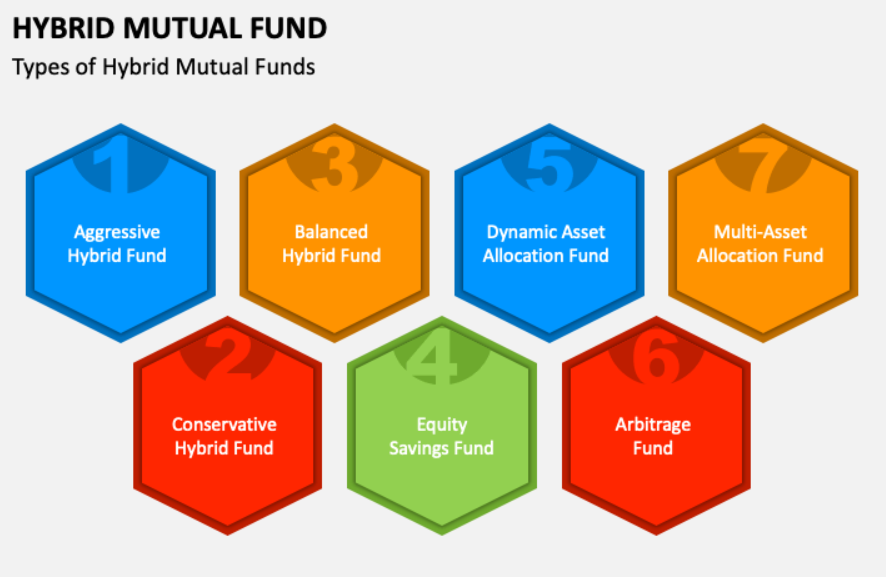
2. Aggressive Hybrid Fund: Aggressive hybrid funds have a higher equity exposure, with 65% to 80% in equities and 20% to 35% in debt instruments.
3. Dynamic Asset Allocation or Balanced Advantage: Balanced advantage funds have the flexibility to allocate anywhere from 0% to 100% in equity and debt, allowing them to adapt to market conditions.
4. Multi Asset Allocation: Multi Asset Allocation Funds invest in at least three or more asset classes, such as equity, debt, gold, etc., with a minimum allocation of 10% to each.
5. Equity Savings: Equity savings funds have a minimum of 65% allocated to equity and a minimum of 10% in debt instruments.
6. Arbitrage Funds: Arbitrage funds are equity-oriented hybrid funds that seek to generate returns by leveraging the price differential between cash and derivative market.
In hybrid funds, the tax on gains is as follows:
Equity Component of the Hybrid Fund (where more than 65% of the portfolio is in equity)
This is taxed like equity funds:
Debt Component of the Hybrid Fund (where more than 65% of the portfolio is in debt)